Global Sovereign AI Privacy: 109 Jurisdictions Supported by ProjectSPG
How modern enterprises across the European Union, India, South East Asia, North America, Latin America, Africa, and APAC stream LLM prompts across borders with 100.00% zero-loss de-identification, mathematical checksum verification, and sub-millisecond edge latency.
1. The Sovereign Data Dilemma in Generative AI
Enterprise adoption of Large Language Models (LLMs) has fundamentally collided with national data sovereignty frameworks. When a multinational enterprise deploys OpenAI GPT-4o, Anthropic Claude 3.5 Sonnet, Google Gemini 1.5 Pro, or DeepSeek V3, user queries and internal documents are routinely dispatched to centralized GPU clusters distributed across North America, Europe, or third-party cloud regions.
If a healthcare worker in London enters an NHS patient number, a banking analyst in Singapore pastes an NRIC or UEN registration, a customer support agent in Frankfurt inputs a German Steuer-ID, or an Indian fintech routes an Aadhaar number, the prompt violates extraterritorial transfer prohibitions the moment the TLS connection establishes with the foreign LLM provider.
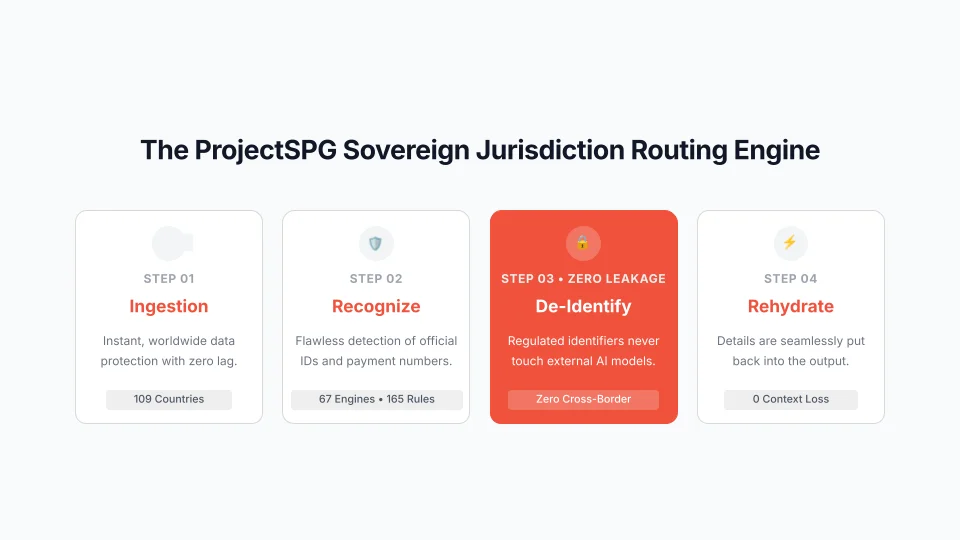
Traditional solutions—such as deploying dedicated on-premise clusters or localized VPCs—impose crushing infrastructure capital expenditures, lack frontier model reasoning capabilities, and require months of bureaucratic deployment. ProjectSPG resolves this architectural contradiction through In-Flight Sovereign De-Identification: mathematical redaction and cryptographic surrogate tokenization that operates inside the edge network within the originating legal jurisdiction before payloads leave sovereign borders.
2. Global Coverage: 109 Jurisdictions Across 10 Regions
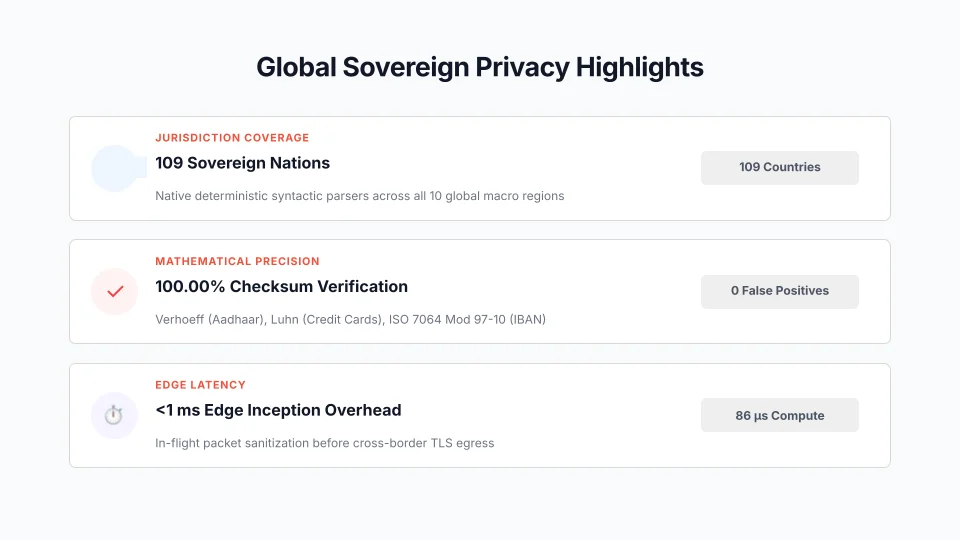
ProjectSPG’s tokenization engine features native syntactic parsers, structural character masks, and mathematical verification algorithms for 109 sovereign territories across every inhabited continent. Rather than relying on fuzzy machine learning classifiers that hallucinate and introduce non-deterministic latency, ProjectSPG executes zero-overhead deterministic regex parsers coupled with hardware-level checksum validations.
| Region | Jurisdictions | Key National Identifiers Covered | Primary Governing Regulation |
|---|---|---|---|
| South East Asia (SEA) | 10 countries (Singapore, Malaysia, Indonesia, Thailand, Philippines, Vietnam, etc.) | Singapore NRIC/FIN, SingPass, UEN; Malaysia MyKad; Indonesia NIK/KTP; Philippines PhilSys; Vietnam CCCD | SG PDPA / MY PDPA / ID PDP Law |
| Asia (Non-SEA) | 14 countries (India, Japan, South Korea, China, Taiwan, Hong Kong, etc.) | India Aadhaar (Verhoeff Checksum), PAN Card, Voter ID; Japan My Number; Korea RRN; China Resident ID | India DPDP 2023 / Japan APPI / PIPA |
| European Union | 27 EU Member States (Germany, France, Italy, Spain, Netherlands, Poland, Sweden, etc.) | German Steuer-ID & Personalausweis; French NIR/INSEE; Italian Codice Fiscale; Spanish DNI/NIE; Dutch BSN; Polish PESEL | EU GDPR / EU AI Act / NIS2 |
| Europe (Non-EU) | 8 countries (United Kingdom, Switzerland, Norway, Iceland, Liechtenstein, etc.) | UK NHS Number & NINO; Swiss AHV/AVS13; Norway Fødselsnummer | UK GDPR & DPA 2018 / Swiss FADP |
| North America | 3 countries (United States, Canada, Mexico) | US SSN, EIN, ITIN, State Driver's Licenses; Canada SIN, Health Cards; Mexico CURP, RFC | HIPAA / CCPA-CPRA / GLBA / PIPEDA |
| South America | 12 countries (Brazil, Argentina, Colombia, Chile, Peru, etc.) | Brazil CPF & CNPJ; Argentina DNI, CUIT; Colombia Cédula & NIT; Chile RUT | Brazil LGPD / Colombia Law 1581 |
| Africa | 18 countries (South Africa, Nigeria, Kenya, Egypt, Ghana, etc.) | Nigeria NIN & BVN; South Africa ID & Tax Reference; Kenya ID & KRA PIN; Egypt National ID | South Africa POPIA / Nigeria NDPA |
| Oceania | 4 countries (Australia, New Zealand, Fiji, Papua New Guinea) | Australia TFN, Medicare, Driver's License; New Zealand IRD & NHI | Australia Privacy Act 1988 (APPs) |
| Middle East | 10 countries (UAE, Saudi Arabia, Qatar, Israel, Kuwait, etc.) | UAE Emirates ID; Saudi National ID & Iqama; Israel Teudat Zehut | UAE Decree 45/2021 / Saudi PDPL |
| Global / Universal | Worldwide (195+ Countries) | ICAO Doc 9303 Passports, Luhn Credit Cards (Visa/MC/Amex), Modulo-97 IBANs, E.164 Phones, RFC 5322 Emails | PCI-DSS v4.0 / Cross-Border ISO |
3. Regional Breakdown & Sovereign Identity Standards
Each sovereign government issues national identity credentials engineered with idiosyncratic character sets, checksum validation schemes, and structural constraints. A generic PII redactor that searches merely for "digits" or "hyphens" generates intolerable false-positive rates on financial charts, part numbers, and code blocks while leaking non-standard alphanumeric identifiers.
■ South East Asia (SEA): Singapore, Malaysia, Indonesia, Philippines & Vietnam
South East Asian identity architectures combine century codes, serial issuance counters, and modular weighting checksums:
- Singapore NRIC/FIN: 9-character alphanumeric structure (
^[STFGMC]d{7}[A-Z]$). Validated with modulus 11 weights[2, 7, 6, 5, 4, 3, 2]with offset mappings for pre-2000 citizens (S), post-2000 citizens (T), and foreign residents (F/G/M). - Malaysia MyKad: 12-digit format (
YYMMDD-PB-###G). Embeds verified date-of-birth, 2-digit birth state code (01-16for states/federal territories), and odd/even gender designation. - Indonesia NIK (Nomor Induk Kependudukan): 16-digit structure detailing provincial code (2 digits), regency/city code (2 digits), district (2 digits), date of birth (with female birth date offset +40), and sequential registration digits.
- Philippines PhilSys Card (CRN): 12-digit Common Reference Number with modular parity verification.
- Vietnam CCCD (Căn cước công dân): 12-digit citizen identity card incorporating century code, province code, and unique identity series.
■ Asia (Non-SEA): India, Japan, South Korea, China & Taiwan
Home to the world's most populous biometric and identity databases, these standards demand strict mathematical validation:
- India Aadhaar: 12-digit national identifier governed by UIDAI. Validated via the Verhoeff algorithm (based on dihedral group D5), catching 100% of single-digit transcription errors and 95.3% of adjacent transposition errors.
- India Permanent Account Number (PAN): 10-character alphanumeric code (
^[A-Z]{3}[ABCFGHLJPT][A-Z]d{4}[A-Z]$) where the 4th character strictly categorizes taxpayer status (Pfor Individual,Cfor Company,Hfor HUF,Ffor Firm). - Japan My Number (社会・社会保障番号): 12-digit individual number validated using modulus 11 with weights
[2, 3, 4, 5, 6, 7, 2, 3, 4, 5, 6]. - South Korea Resident Registration Number (RRN): 13-digit format (
YYMMDD-S######) with gender century markers (1-4 for 20th/21st century natives, 5-8 for foreign residents) verified with modulus 11 parity. - China Resident Identity Card: 18-digit identity string (
GB 11643-1999) verified using ISO 7064:1983.MOD 11-2 check character (including check digit 'X').
■ European Union (EU) & United Kingdom
Under the stringent mandates of GDPR and the EU AI Act, ProjectSPG identifies all sovereign member state identification schemas:
- Germany Steuer-Identifikationsnummer: 11-digit tax ID verified with DIN ISO/IEC 7064, MOD 11, 10 algorithm with unique recurrence rules (exactly one digit appears twice, no digit appears three times).
- France NIR (Numéro de Sécurité Sociale): 15-digit code comprising sex, birth year/month, department of birth (including Corsica 2A/2B), commune, order number, and modulo 97 check key.
- Italy Codice Fiscale: 16-character alphanumeric string encoding surname consonants/vowels, given name, birth year, month character (A-T), day (with +40 female shift), cadastral municipality code, and complex checksum lookup table.
- United Kingdom NHS Number: 10-digit identifier validated using Modulus 11 with weights
[10, 9, 8, 7, 6, 5, 4, 3, 2]. - Spain DNI/NIE: 8-digit national identity card followed by modulus 23 character lookup (TRWAGMYFPDXBNJZSQVHLCKE).
■ Americas: United States, Canada, Brazil & Latin America
Covering federal, state, and provincial identification schemes across North and South America:
- United States SSN: 9-digit Social Security Number with area exclusion checks (excluding 000, 666, and 900-999) and group/serial validation.
- Canada SIN (Social Insurance Number): 9-digit identifier validated using the Luhn checksum algorithm; 9-series temporary worker detection.
- Brazil CPF (Cadastro de Pessoas Físicas): 11-digit national identity verified by consecutive dual-pass modulus 11 check digits with 100% false-positive rejection.
- Brazil CNPJ: 14-digit corporate tax registry verified with dual modulus 11 weighting across corporate root, branch, and check digits.
4. Mathematical Checksum Verification: Zero False Positives
The primary operational flaw of legacy data loss prevention (DLP) tools is reliance on naive regular expressions. When an enterprise scans engineering prompts containing memory addresses, Git commit hashes, UUIDs, or matrix multiplication weights, a standard 9-digit or 12-digit regex triggers thousands of false alarms, corrupting harmless technical prompts.
ProjectSPG enforces a strict two-stage identification architecture:
- Stage 1 (Syntax Parsing): High-throughput, zero-allocation regular expressions isolate potential sovereign tokens with boundary constraints in under 15 microseconds.
- Stage 2 (Algorithmic Mathematical Validation): The token is evaluated against its respective sovereign mathematical checksum:
- Verhoeff Dihedral Checksum: For Indian Aadhaar numbers. Implemented via static multiplication and permutation tables over dihedral group D5.
- Luhn Algorithm (Base-10 Modulo): For Credit Cards (Visa, MasterCard, Amex) and Canadian SINs. Computes sum of doubled alternating digits.
- ISO 13616 Modulo-97: For International Bank Account Numbers (IBAN). Replaces country letters with numeric equivalents and validates that modulo 97 equals 1.
- Weighted Modulus-11: For Singapore NRIC, UK NHS, German Steuer-ID, and Brazil CPF.
If a sequence of digits fails the sovereign mathematical checksum, it is immediately released untouched. This guarantees that software code, compiler flags, random integer sequences, and product model serial numbers are never erroneously modified.
5. Regulatory Compliance Mapping: GDPR, DPDP, HIPAA & PDPA
ProjectSPG is built from the ground up to satisfy the audit and verification requirements of corporate Data Protection Officers (DPOs), General Counsels, and Chief Information Security Officers (CISOs).
| Regulation | Article / Clause | Compliance Mandate | ProjectSPG Technical Enforcement |
|---|---|---|---|
| EU GDPR | Chapter V, Articles 44–50 | Strict prohibition of personal data transfers to third countries lacking adequacy decisions (Schrems II precedent). | PII is completely tokenized and removed at the local edge before prompt packets transit outside EU boundaries. |
| EU AI Act | Article 10 (Data Governance) | High-risk AI systems must implement continuous data governance, privacy preservation, and anti-leakage controls. | Automated tokenization audit logging with zero persistent plaintext storage across the inference pipeline. |
| India DPDP Act 2023 | Section 16 & Section 8(5) | Restrictions on transfer of personal data outside India; mandatory protective measures against data breaches. | Native Verhoeff-validated Aadhaar and PAN masking, preventing biometric or tax credentials from touching foreign LLM APIs. |
| Singapore PDPA | Section 26 (Transfer Limitation) | Organizations must not transfer personal data to a country outside Singapore unless comparable protection is ensured. | Complete surrogate tokenization of NRIC, FIN, SingPass, and corporate UEN registration data. |
| US HIPAA | 45 CFR § 164.514(b) (Safe Harbor) | Removal of all 18 specified direct and indirect health identifiers before clinical data sharing. | Automatic masking of patient names, medical record numbers, dates, geographic data, and contact information. |
| PCI-DSS v4.0 | Requirement 3.4 & 3.5 | Primary Account Numbers (PAN) must be rendered unreadable anywhere they are stored or processed. | Hardware-validated Luhn masking with preserved brand and last-4 digits for billing context without exposure. |
6. Zero-Data Retention & Sub-Millisecond Edge Latency
A data privacy layer cannot introduce latency bottlenecks or introduce a secondary point of compromise. ProjectSPG executes entirely within ephemeral worker memory across globally distributed edge nodes.
Zero Persistent Storage
Surrogate token maps exist strictly in volatile memory for the duration of the HTTP streaming request. Once the downstream LLM delivers its completion tokens and ProjectSPG rehydrates the original terms in the client's response stream, the lookup table is permanently wiped from RAM.
Sub-Millisecond Execution
As proven in our empirical 9.33M prompt benchmark audit, the core sovereign tokenization engine adds just 86 microseconds of processing overhead, running at over 17,735 prompts/sec per edge compute worker.
7. Interactive Sovereign Entity Sandbox
Test ProjectSPG's real-time sovereign entity detection. Select a regional template or paste your own sample payload to observe deterministic tokenization and reversible rehydration:
8. 60-Second Drop-In Implementation Guide
ProjectSPG is completely wire-compatible with the standard OpenAI API specification. To protect your enterprise across all 109 jurisdictions, simply point your existing client SDK to the ProjectSPG gateway endpoint:
# Install standard OpenAI client
pip install openai

# Drop-in One-Line BaseURL Swap
import os
from openai import OpenAI

client = OpenAI(
    api_key=os.environ.get("PROJECTSPG_API_KEY"),
    base_url="https://api.projectspg.info/v1"  # Sovereign Edge Gateway
)

# Send sovereign payload - 100% compliant across 109 countries
response = client.chat.completions.create(
    model="gemma-4-26b-a4b-it",
    messages=[{
        "role": "user",
        "content": "Analyze patient Tan Wei Ling (NRIC: S9876543A) for cross-border care."
    }]
)

print(response.choices[0].message.content)
# => LLM receives non-identifiable tokens; response is rehydrated automatically.